Join Mike to view his first
aquaponics system.
Follow Mike as he grows with his system and learns
the ups and downs of aquaponics.
Mike will be providing regular updates
so you can see how his system is doing in the heat of sunny Florida.
Aquaponics //, is a
food production system that combines conventional
aquaculture, (raising
aquatic animals such as snails,
fish,
crayfish or
prawns in tanks), with
hydroponics (cultivating plants in water) in a
symbiotic environment.
In normal aquaculture,
excretions
from the animals being raised can accumulate in the water, increasing
toxicity.
In an aquaponic system, water from an aquaculture system is
fed to a
hydroponic system where the
by-products are broken down by
nitrogen-fixing bacteria into
nitrates and
nitrites, which are utilized by the plants as nutrients.
The water is then recirculated back to the aquaculture system.
As existing hydroponic and aquaculture farming techniques form the
basis for all aquaponics systems, the size, complexity, and types of
foods grown in an aquaponics system can vary as much as any system found
in either distinct farming discipline.
[1]
History
Aquaponics has ancient roots, although there is some debate on its first occurrence:
- Aztec cultivated agricultural islands known as chinampas in a system considered by some to be the first form of aquaponics for agricultural use[2][3]
where plants were raised on stationary (and sometime movable) islands
in lake shallows and waste materials dredged from the Chinampa canals
and surrounding cities were used to manually irrigate the plants.[2][4]
- South China, Thailand, and Indonesia who cultivated and farmed rice in paddy fields in combination with fish are cited as examples of early aquaponics systems.[5] These polycultural farming systems existed in many Far Eastern countries and raised fish such as the oriental loach (泥鳅, ドジョウ),[6] swamp eel (黄鳝, 田鰻), Common (鯉魚, コイ) and crucian carp (鯽魚) [7] as well as pond snails (田螺) in the paddies.[8][9]
Floating aquaponics systems on polycultural fish ponds were installed in
China in more recent years on a large scale growing rice, wheat and
canna lily and other crops,
[10] with some installations exceeding 2.5 acres (10,000 m
2).
[11]
The development of modern aquaponics is often attributed to the various works of the
New Alchemy Institute and the works of Dr. Mark McMurtry et al. at the
North Carolina State University.
[13]
Inspired by the successes of the New Alchemy Institute, and the
reciprocating aquaponics techniques developed by Dr. Mark McMurtry et
al., other institutes soon followed suit.
Starting in 1997, Dr. James
Rakocy and his colleagues at the
University of the Virgin Islands researched and developed the use of
deep water culture hydroponic grow beds in a large-scale aquaponics system.
[12]
The first aquaponics research in
Canada was a small system added onto existing aquaculture research at a research station in
Lethbridge,
Alberta.
Canada saw a rise in aquaponics setups throughout the ’90s,
predominantly as commercial installations raising high-value crops such
as trout and lettuce.
A setup based on the deep water system developed
at the University of Virgin Islands was built in a greenhouse at
Brooks, Alberta
where Dr. Nick Savidov and colleagues researched aquaponics from a
background of plant science.
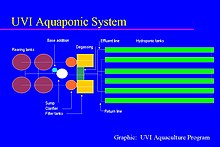
Diagram of the University of the Virgin Islands commercial aquaponics system designed to yield 5 metric tons of
Tilapia per year.
[12]
The team made findings on rapid root growth
in aquaponics systems and on closing the solid-waste loop, and found
that owing to certain advantages in the system over traditional
aquaculture, the system can run well at a low pH level, which is
favoured by plants but not fish.
The Caribbean island of
Barbados
created an initiative to start aquaponics systems at home, with revenue
generated by selling produce to tourists in an effort to reduce growing
dependence on imported food.
In
Bangladesh, the
world's most densely populated country, most farmers use
agrochemicals
to enhance food production and storage life, though the country lacks
oversight on safe levels of chemicals in foods for human consumption.
[14]
To combat this issue a team led by Professor Dr. M.A. Salam at the Department of
Aquaculture of
Bangladesh Agricultural University,
Mymensingh
has created plans for a low-cost aquaponics system to provide
chemical-free produce and fish for people living in adverse climatic
conditions such as the salinity-prone southern area and the flood-prone
haor area in the eastern region.
[15][16]
Dr. Salam's work innovates a form of
subsistence farming
for micro-production goals at the community and personal levels whereas
design work by Chowdhury and Graff was aimed exclusively at the
commercial level, the latter of the two approaches take advantage of
economies of scale.
There has been a shift towards community integration of aquaponics, such as the nonprofit foundation
Growing Power that offers
Milwaukee
youth job opportunities and training while growing food for their
community.
The model has spawned several satellite projects in other
cities, such as New Orleans where the Vietnamese fisherman community has
suffered from the
Deepwater Horizon oil spill, and in the
South Bronx in
New York City.
[17]
Whispering Roots is a non-profit organization in
Omaha, Nebraska
that provides fresh, locally grown, healthy food for socially and
economically disadvantaged communities by using aquaponics, hydroponics
and urban farming.
[18]
In addition, aquaponic gardeners from all around the world have
gathered in online community sites and forums to share their experiences
and promote the development of this form of gardening
[19] as well as creating extensive resources on how to build home systems.
Recently, aquaponics has been moving towards indoor production
systems. In cities like Chicago, entrepreneurs are utilizing vertical
designs to grow food year round.
[20]
Components
Aquaponics consists of two main parts, with the aquaculture part for
raising aquatic animals and the hydroponics part for growing plants.
[21][22]
Aquatic effluents, resulting from uneaten feed or raising animals like
fish, accumulate in water due to the closed-system re-circulation of most
aquaculture systems.
The effluent-rich water becomes toxic to the
aquatic animal in high concentrations but these effluents are
nutrients essential for plant growth.
[21]
Although consisting primarily of these two parts, aquaponics systems
are usually grouped into several components or subsystems responsible
for the effective removal of solid wastes, for adding
bases to neutralize
acids, or for maintaining
water oxygenation.
[21]
Typical components include:
- Rearing tank: the tanks for raising and feeding the fish;
- Settling basin: a unit for catching uneaten food and detached biofilms, and for settling out fine particulates;
- Biofilter: a place where the nitrification bacteria can grow and convert ammonia into nitrates, which are usable by the plants;[21]
- Hydroponics subsystem: the portion of the system where plants are grown by absorbing excess nutrients from the water;
- Sump: the lowest point in the system where the water flows to and from which it is pumped back to the rearing tanks.
Depending on the sophistication and cost of the aquaponics system,
the units for solids removal, biofiltration, and/or the hydroponics
subsystem may be combined into one unit or subsystem,
[21] which prevents the water from flowing directly from the aquaculture part of the system to the hydroponics part.

A commercial aquaponics system. An electric pump moves
effluent
rich water from the fish tank through a solids filter to remove
particles the plants above cannot absorb. The water then provides
nutrients for the plants and is cleansed before returning to the fish
tank below where the process repeats.
Plants are grown as in hydroponics systems, with their roots immersed in
the nutrient-rich effluent water.
This enables them to filter out the
ammonia that is toxic to the aquatic animals, or its metabolites.
After
the water has passed through the hydroponic subsystem, it is cleaned and
oxygenated, and can return to the aquaculture vessels.
This cycle is
continuous. Common aquaponic applications of hydroponic systems include:
- Deep-water raft aquaponics: styrofoam rafts floating in a relatively deep aquaculture basin in troughs.
- Recirculating aquaponics: solid media such as gravel or clay beads, held in a container that is flooded with water from the aquaculture. This type of aquaponics is also known as closed-loop aquaponics.
- Reciprocating aquaponics: solid media in a container that is
alternately flooded and drained utilizing different types of siphon
drains. This type of aquaponics is also known as flood-and-drain aquaponics or ebb-and-flow aquaponics.
- Other systems use towers that are trickle-fed from the top, nutrient film technique channels, horizontal PVC pipes with holes for the pots, plastic barrels cut in half with gravel or rafts in them. Each approach has its own benefits.[23]
Most green
leaf vegetables grow well in the hydroponic subsystem, although most profitable are varieties of
chinese cabbage,
lettuce,
basil,
roses,
tomatoes,
okra,
cantaloupe and
bell peppers.
[22]
Other species of vegetables that grow well in an aquaponic system include
beans,
peas,
kohlrabi,
watercress,
taro,
radishes,
strawberries,
melons,
onions,
turnips,
parsnips,
sweet potato and
herbs.
[citation needed]
Since plants at different growth stages require different amounts of
minerals and nutrients, plant harvesting is staggered with seedings
growing at the same time as mature plants. This ensures stable nutrient
content in the water because of continuous symbiotic cleansing of toxins
from the water.
[24]

A Deep Water Culture hydroponics system where plant grow directly into the effluent rich water without a
soil
medium. Plants can be spaced closer together because the roots do not
need to expand outwards to support the weight of the plant.
Animals: aquaculture
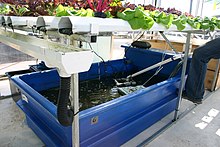
Filtered water from the hydroponics system drains into a
catfish tank for re-circulation.
Main article:
Aquaculture
Freshwater fish are the most common aquatic animal raised using
aquaponics, although freshwater crayfish and prawns are also sometimes
used.
[25]
In practice,
tilapia are the most popular fish for home and commercial projects that are intended to raise edible fish, although
barramundi,
Silver Perch,
Eel-tailed catfish or tandanus catfish,
Jade perch and
Murray cod are also used.
[22]
For temperate climates when there isn't ability or desire to maintain water temperature,
bluegill and
catfish are suitable fish species for home systems.
Koi and
goldfish may also be used, if the fish in the system need not be edible.
Bacteria
Nitrification, the
aerobic
conversion of ammonia into nitrates, is one of the most important
functions in an aquaponics system as it reduces the toxicity of the
water for fish, and allows the resulting nitrate compounds to be removed
by the plants for nourishment.
[21]
Ammonia is steadily released into the water through the
excreta and
gills
of fish as a product of their metabolism, but must be filtered out of
the water since higher concentrations of ammonia (commonly between 0.5
and 1
ppm)
[citation needed] can kill fish.
Although plants can absorb ammonia from the water to some degree, nitrates are assimilated more easily,
[22] thereby efficiently reducing the toxicity of the water for fish.
[21]
Ammonia can be converted into other nitrogenous compounds through healthy populations of:
In an aquaponics system, the bacteria responsible for this process form a
bio-film
on all solid surfaces throughout the system that are in constant
contact with the water.
The submerged roots of the vegetables combined
have a large surface area, so that many bacteria can accumulate there.
Together with the concentrations of ammonia and nitrites in the water,
the surface area determines the speed with which nitrification takes
place.
Care for these bacterial colonies is important as to regulate the
full assimilation of ammonia and nitrite. This is why most aquaponics
systems include a bio-filtering unit, which helps facilitate growth of
these
microorganisms.
Typically, after a system has stabilized ammonia levels range from 0.25
to 2.0 ppm; nitrite levels range from 0.25 to 1 ppm, and nitrate levels
range from 2 to 150 ppm.
[citation needed]
During system start-up, spikes may occur in the levels of ammonia (up to
6.0 ppm) and nitrite (up to 15 ppm), with nitrate levels peaking later
in the start-up phase.
[citation needed]
Since the nitrification process acidifies the water, non-
sodium bases such as
potassium hydroxide or
calcium hydroxide can be added for neutralizing the water's
pH[21]
if insufficient quantities are naturally present in the water to
provide a buffer against acidification.
In addition, selected minerals
or nutrients such as iron can be added in addition to the fish waste
that serves as the main source of nutrients to plants.
[21]
A good way to deal with solids buildup in aquaponics is the use of
worms, which liquefy the solid organic matter so that it can be utilized
by the plants and/or animals.
Source: Wikipedia.org
Somebody Come and Play Today! Earn as You Learn, Grow as You Go!
The Man Inside the Man
from
Sinbad the Sailor Man
A
JMK's Production
Share this page
TTFN
CYA Later Taters!
Thanks for stopping by.
Donnie/Sinbad the Sailor Man
P.S. Sweet Sixteen My Breakout Year's Hottest and Fastest Growing Biz Op? Do You Want In? If You Do!
Click Here and Sign Up!


